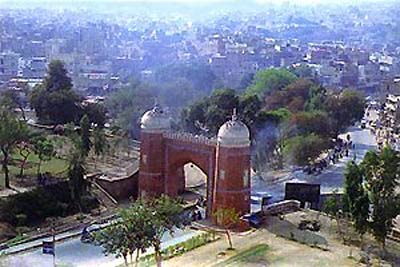
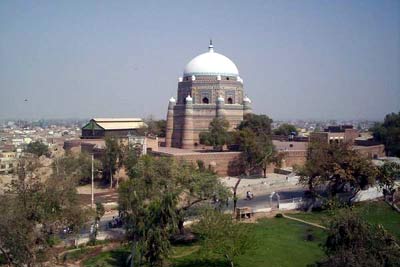
Multan, now in modern Pakistan is rich in archtecture
|
|
| Multan, now in modern Pakistan is rich in archtecture |
|
On the 17th of November 1920, they left occupied Turkey for Multan in India. During the summer of 1921, the battalion was sent to hill stations at Kasauli, Solon in the Simla Hills. On October the 18th 1921, Major J. S. Higginson was appointed to command the battalion. During their time in Multan, they were called out to quell nationalist unrest.
The city of Multan is located in southern Punjab province at almost the exact centre of Pakistan. The area around the city is a flat plain and is ideal for agriculture, with many citrus and mango farms. There are many canals that cut across the Multan District, providing water from nearby farms. This makes the land very fertile. However usually land close to the Chenab are usually flooded in the monsoon season. The city also witnesses some of the most extreme weather in the country. During summertime, temperatures reach approximately 54 °C, and in the winter −1 °C has been recorded. The average rainfall is roughly 127mm. Dust storms are also a common occurence within the city.
After a long and bloody battle, Multan had been made part of the British Raj. During the time of British rule, Sardar Karan Narain's son became an icon during the British Raj and was awarded titles 'Rai Bahadur' and Knighted 'Sir' by Her Majesty. The British built some rail routes to the city, but its industrial capacity was never developed.
On the 1st of January 1922, the designation 'Fusilier' replaced that of 'Private' in the Royal Dublin Fusiliers.
In February 1922, a telegram was received at Headquarters, Lahore District, announcing that the battalion was to move to England in March. The war in Ireland had caused the return of the 2nd Dublins from India to England.