 |
 |
|
|
Born circa 1893 according to CWGC information and 1892 fron 1911 census. There is no record of a birth in Ireland or Scotland, and if he were born in England it would have to be Henry Angliss born Apr/Jun 1887 at Foleshill, Warcs (6d p475), but this does not fit with with a date of birth in 1892 or 1893. Further his army census information in 1911 says he was born "Balmaine, Dublin", which I cannot find. Son of Henry Angliss, of Enniskillen is given by CWGC.
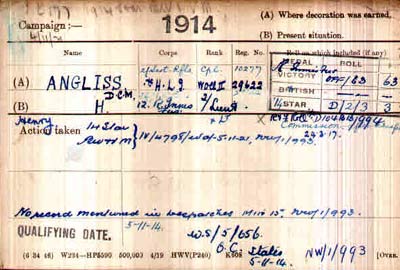
1908 He enlisted at the end of 1908 as in the Scottish Rifles, regulars were given numbers in the 10,300 range, in Jan 1909

1911 census gives us Private Henry Angliss of Scottish Rifles at Meeanee Barracks, Colchester. Aged 19 (ie born circa 1892) born Balmaine, Dublin
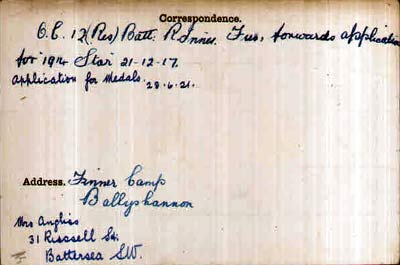
1913 A Henry Angliss married Oct/Dec 1913 to Ellen E Musk at Holborn Vol 1b p1138 and/or to Ellen C M Finnerty at Wandsworth vol 1d p1470 in Apr/Jun 1919
1914 August: in Malta. Returned to England, landing at Southampton 22 September 1914. Attached to 23rd Brigade, 8th Division.
1914 He entered the war in France 5 Nov 1914 with 2nd Scots Rifles where he reached the rank of Corporal, then became a WOII in Highland Light Infantry, before being commissioned into Royal Inniskilling Fusiliers
1916 Oct 22. Awarded DCM, gazetted 11 Dec 1916. "At 7pm on the 22nd October Sgt Angliss led a raiding party of 14 O.R. through a gap in the enemy wire and found the trench full of Germans. He jumped into the trench and killed two and when overwhelmed by numbers he conducted the retirement of his party in a most able manner. He carried back himself the only wounded man in the party. After doing so he returned to "No Mans Land" and was gone for two hours, under heavy fire,searching for wounded of the raiding party who had gone out on the right,simultaniously with his own.
1916 Nov 27 Sgt Angliss is presented with his DCM by the G.O.C.
1917 Apr 2. 2nd Lt H. Angliss, D.C.M. (R. Innis. Fus.). 15 July 1918, with seniority 2 Apr. 1917.
1917 Dec Army List The Royal Inniskilling Fusiliers, 1st & 2nd Bn’s 2nd Lieutenants Angliss, H. 2 Apr17 (attached 11th Bn)
1918 Oct. 2. 2nd Lte. to be Lt.: R. Innis. Fus.
1918 Dec Army List The Royal Inniskilling Fusiliers 1ST & 2nd Bn’s 2nd Lieutenant Angliss H; D.C..M, 2 Apr 17 (Employed with Machine Gun Corps)
If one believes the information found on him, he was posted to Russia by the army. They called it " Churchill's War," "The Great Russian Gamble," and "Whitehall’s Folly." More than 600 British and Commonwealth soldiers were killed and wounded there, but unknown now in Britain. No official history was ever written of it, no medals or stars were struck. The North Russian campaign lasted from May 1918 to October 1919. Britain sent troops to Murmansk and Archangel in northern Russia. They were part of an international force designed to protect Allied interests there during the Russian Civil War, and to offer assistance to those Russian forces fighting the Bolsheviks in that conflict. Altough the Inniskillings were not there, included in the British Expeditionary Force was 8th Battalion Machine Gun Corps and 8, 201, 252, 280 Machine Gun Companies
He was believed to have then recalled from the British Expeditionary Force in Russia to serve in Ireland as an intellegence specialist in the South Dublin area.
1919 Dec Army List The Royal Inniskilling Fusiliers 1st & 2nd Bn’s Lieutenant Angliss H: D.C..M. 2 Oct 18 (Employed with Machine Gun Corps)
1919 Dec. 13. Lt. H. Angliss, D.C.M. (R. Innis. Fus.), ceases to be employed with the Machine Gun Corps .
Henry James Angliss, who incidentally served in 8th (S) Battalion MGC in North Russia. Apparently when Lieutenant William Genders (also 8th Battalion MGC) returned from Russia he was recruited with another MGC man by Basil Thomson of Scotland Yard for intelligence work in Ireland and that the other man was shot by the IRA. The assumption is this other man was Angliss though there is no proof of this.
1920 Mar 17. R. Innis. Fus., H. Angliss, D.C.M., retires, receiving a gratuity.
It is at this point that I loose him in military records. In spite of the fact that he is gazetted as retiring in Mar 1920, he was a serving officer when shot 8 months later.He had survived a previous assassination attempt when shot at a billiard hall. He used the alias Patrick McMahon as a cover.
1920 Sept. Following the execution of John Lynch, a legal clerk, in September 1920 in his hotel bed by the Cairo Gang., Apparently Lt. Angliss, drunk and despondent, divulged his participation in the execution to a girl who inadvertently passed this information to an IIS informant. The remaining members of the group were identified after an unwitting landlady revealed to another IIS informant that several of her British guests regularly went out very late in the evening. At the time Dublin was under a very strict curfew, and only authorized personnel were allowed on the streets. The individuals in question were taken under observation by the surveillance and enforcement arm of the IIS -- called the Twelve Apostles -- who determined that they were in contact with previously identified members of the Cairo Group.
The following IRA men appear to have been involved. The group appears to have numbered 11 on IRA data. It appears that 5 entered the house and the others were on guard outside
Tom Keogh, Jim Slattery, Frank Teeling, Denis Begley, and Andy Monaghan went into 22 Lower Mount Street looking for Lieutenant H. McMahon. They found the man, whose real name was Angliss, in bed with the man who became the inquest’s relatively notorious ‘Mr C’. He testified at Teeling’s court-martial that I was awakened about 9 a.m. by someone shouting ‘Hands up’ when I opened my eyes I saw five men standing at the end of my bed covering me with revolvers. One of the men who appeared to be acting as leader gave the order to keep McMahon and myself covered and he proceeded to search the room. He picked up a civilian coat belonging to McMahon and said ‘ is this your coat McMahon’, McMahon said ‘No.’ He then put his hand in the inside pocket, took out a wallet and said ‘You’re a damned liar ’ and put the wallet in his pocket. He then said ‘where are your guns Mac’. McMahon said ‘look here we are two R[oman] C[atholic]s but the guns are in that bag’. The man then walked over to the bag which was lying in a corner of the room, lifted it on to the table and burst the locks off with his hands and took out three revolvers. They were one service Colt, one Webly-Scott Automatic and one .32 automatic. He put them in his pockets. I then heard firing which seemed to come from the street and I heard a noise as if someone was trying to smash in the front door. A man’s voice on the landing then shouted ‘are you all right there boys. They’re surrounding the house.’ The five men in the room then turned as if to rush out, they went a little way down the room then halted and the man who had been doing the searching raised his revolver – pointed it at the bed and fired. I saw McMahon raise his arm to cover his face and at the same time I threw myself out of the bed on to the floor practically simultaneously I heard other shots ring out from the other men in the room and they all rushed out of the room. McMahon was shot three times in the chest and once in the buttock.
The officer in the next room (Peel) barricaded his door. Seventeen shots failed to penetrate it and he was saved. Outside some passing Auxiliaries had been alerted by the screaming of the maids. Two of their number, Temporary Cadets F. Carniss and C. A. Morris, were sent to Beggar’s Bush barracks for reinforcements. But they were met by some of the IRA guards posted around the house, brought to the garden of 16 Northumberland Road and shot.
After a brief exchange of fire, in which Teeling was shot, all the rest escaped from Lower Mount Street, but not before Tom Keogh stopped to make a date with one of the maids. Denis Begley’s account was a little different from Mr C’s. C. was after all considered a ‘drunkard and a coward if not worse… suffering from shell-shock and neurasthenia ’. There was talk of an illegitimate child with the maid downstairs. Begley’s version was much simpler. Tom Keogh uttered ‘Carry on lads ’ and McMahon was shot dead.
Na Fianna Eireann (Irish Republican Scouts) were on Lower Mount Street that Sunday morning , as 'lookouts' ; one of their members ran into number 22 to tell the eleven-person IRA unit that the British Auxiliaries were on the street - five members of the IRA unit left by the front door , the other six men went out the back-door and walked away up a laneway. These six men were challenged by a number of Auxiliaries and a gun battle ensued - IRA man Frank Teeling was wounded. The wounded Volunteer, Teeling, was captured, but the rest of his unit made good their escape.
Two assassins managed to escape but a third, Frank Teeling, was wounded and captured. The fugitives shot their way out through the front of the building, ran down Grattan Street and, according to Leeson, "escaped across the Liffey on a commandeered ferryboat."
Hansard report says The maid opened the door, twenty men rushed in (the IRA say 11 men), and demanded to know the bedrooms of Mr. Mahon (Angliss) and Mr. Peel. Mr. Mahon's room was pointed out. They entered, and five shots were fired immediately at a few inches range. Mr. Mahon was killed. At the same time others attempted to enter Mr. Peel's room. The door was locked. Seventeen shots were fired through the panels. Mr. Peel escaped uninjured. Meanwhile another servant, hearing the shots, shouted from an upper window to a party of officers of the Auxiliary Division who had left Beggars Bush Barracks to catch an early train southward for duty. These officers at once attacked the house, after despatching two of their number, Temporary Cadets Morris and Garniss, to their depôt for reinforcements. They chased the assassins through the house and captured one whom their fire had wounded (Frank Teeling, was wounded and captured. Teeling subsequently escaped from Kilmainham Jail) and three others, all of whom were armed. Reinforcements on arrival were asked the whereabouts of Morris and Garniss, but replied that they knew nothing, and that the cadets had never arrived at the depôt. The reinforcements had arrived after hearing the firing, rather than from being warned by Morris and Garniss.
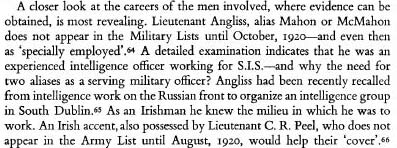
A badly researched article entitled "Bloody Sunday, a reappraisal" by T Bowden of University of Manchester in European History Quarterly states that Angliss did not appear in Military lists till Oct 1920
Three IRA Volunteers were accused on murdering Lieutenant H Angliss at 22 Lower Mount Street. The three were tried under Field General Court-Martial in January 1921.
Lieutenant Henry James Angliss in Royal Inniskilling Fusiliers died aged 27 on 21/11/1920 Winner of the Distinguished Conduct Medal. husband of Ellen Angliss, of 295, Cannhall Rd., Leytonstone, London. Recorded on Leytonstone War Memorial. His death is recorded in Irish Civil Records Dublin South, Oct - Dec 1920 Vol 2, p 513
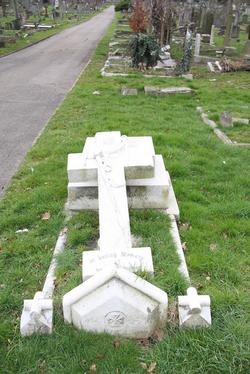
Buried in a CWGC at Wandsworth (Earlsfield) Cemetery
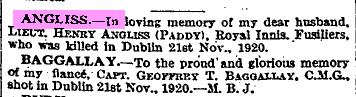
The Times 21 Nov 1921
Belmayne, Dublin's most stylish new address, is just off the Malahide Road, across the road from the Hilton Hotel,